What each sample can tell you
- Before the load-bank test
- To track fuel left by routine light runs, take a warm sample late in the last light run. Use the same point in the routine each year.
- After the load-bank test
- The oil has been hotter. Some lighter fuel may have evaporated. Record the timing so the lab knows which samples it can compare.
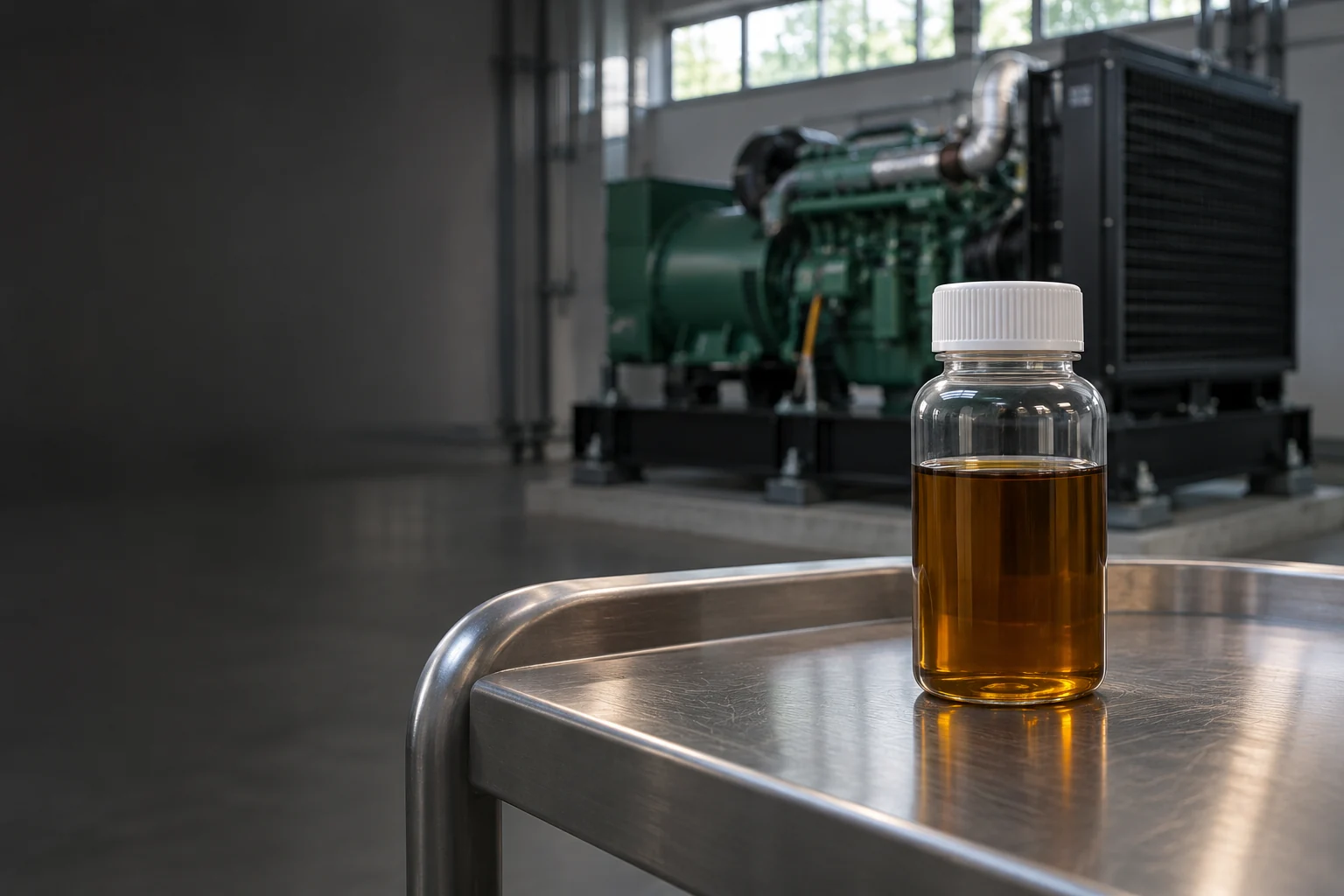
Take a standby generator that has run ten times since its oil change, half an hour each time with the data hall still on the mains. The engine carried little or no load. Any of them could have sent unburned diesel past the piston rings into oil nobody has looked at since.
The eleventh run and the oil sample are due next week, the annual load-bank test a month later. The contractor asks whether to sample before the load bank or after it.
For a trend of what those light runs leave in the sump, take the sample before the load bank. Three loaded hours can change the fuel left in the oil. Here is why that timing matters.
A light run wets the sump
At light load, a diesel engine may not maintain the temperatures needed to burn its fuel completely. The manufacturer guidance below uses about 30% of rating as a practical reference, not a universal threshold for every engine. Kohler, Cummins and Generac all draw the line there. Kohler's explanation is that at light load there is too little pressure in the cylinder to press the rings out against the liner, so they seal poorly.
Unburned fuel then has two ways out. One is the exhaust, as the drips and black smoke of wet stacking. The other runs down the cool liner and past the rings into the oil pan. The first is the one people notice. Nobody watches the sump.
Some findings do not wait for a bottle. Drips at the exhaust outlet, black smoke under steady load, an oil level that climbs between checks or a failed load test go straight to the generator service provider under the site's procedure. Our guide to routing a result explains why.
The makers' remedy is load. For a set that usually runs light, Cummins asks for at least three hours a year, one of them near rated load. Kohler argues that some modern engines, with common-rail injection and finer ring tolerances, need loaded running as little as once a year: the routine in this log.
Not the fuel that went in
Diesel is a blend of fractions, and the lightest are the first to leave hot oil. Conventional diesel can boil back out, an NREL paper notes, while biodiesel, which boils higher, tends to stay. Fuel that enters on a cool half-hour run has less chance to leave than fuel that enters during three loaded hours.
What remains after any run is weighted towards the heavy end, and it ages in the crankcase. ASTM D7593, the gas chromatography method for in-service engine oil, is candid about this: it does not claim to quantify the specific fuel present accurately, and normalises diesel to a simulated aged fuel instead.
The older method, ASTM D3524, written for SAE 30 oils, adds a second caution. Diesel and those oils overlap in boiling range, and the oils themselves vary, so the choice of calibration oil alone can move the result by as much as 2 points of fuel dilution. Precision is better with a new oil like the one under test.
So next week's bottle travels with a sealed sample of the same new oil as a reference, and with a note of where in the exercise year it was taken.
Two moments, one trend
ExxonMobil's oil analysis guide sets out the basics: sample at operating temperature through a sampling valve, from the same point at a consistent interval, with stagnant oil drawn off the connection first. It is blunt on one point: do not take a cold sample.
For a standby set that means late in a run, not from a cold sump on a quiet morning. A light run may never bring the oil fully up to working temperature, so note how warm the engine got.
A sample late in the eleventh run catches the oil at the end of the light series, holding whatever those runs left behind. A sample after the load bank catches oil fresh from three loaded hours, with its lightest fuel given the best chance to leave.
For the fuel question the sample before the load bank is the one: the routine's effect is largest there. Write that position into the sampling schedule, so the next contractor does not quietly move it. The line on the request can be this short:
Fuel dilution trend sample. Taken warm, late in the last light exercise run before the annual load-bank test, from the same sampling point as every year. Sealed sample of the same new oil enclosed.
Screen or quantify
If the result will be read against a limit or decide an oil change, ask for a quantified result and send the reference oil. If the question is only whether fuel is there and rising, viscosity, flash point and infrared can carry the trend, as long as everyone knows they do not size it.
Viscosity: which way, not how much
Diesel is thin. Indian automotive diesel is specified at 2.0 to 4.5 mm²/s at 40 °C, where a 15W-40 engine oil sits near 109 mm²/s. Fuel pulls viscosity down, while oxidation and soot push it up, so a reading inside grade has not cleared the oil of fuel. A viscosity drop is a flag with a direction, never a percentage.
Flash point and infrared: there, and rising
Flash point is the sharper screen. Diesel to the Indian specification may flash as low as 35 °C closed cup, a 15W-40 at 200 °C or more open cup, so a little fuel moves the closed-cup result a long way. ASTM D93 lists detecting volatile contamination among its uses, though its precision for in-use lubricating oils has not been determined.
It can say fuel is there; it cannot say how much.
Infrared (FTIR) under ASTM E2412 is a trending practice. It follows fuel among several contaminants and is often not calibrated to a concentration, so it shows fuel rising.
Gas chromatography: how much
ASTM D7593 quantifies up to 10% by mass for diesel and biodiesel. The method itself says some fuel dilution is normal and that excess can lead to premature wear or sudden engine failure. Where the line sits is the engine maker's call and the site's.
What goes with the bottle
The bottle cannot say where in the year it was filled, how hard the set ran or which oil went in; the request can.
- Runs: date, length and load of every run since the oil change, how warm the engine got and the hours since the last loaded run.
- Position: before or after the annual load-bank test, the same every year.
- Oil: product and grade, hours and months in service, top-ups and a sealed sample of the same new oil.
- Fuel: grade, any biodiesel content and the date of the last delivery.
- Question: trend only, or a number against a limit, and who set the limit.
Before the load bank
The contractor's answer is before. Next week the bottle is filled warm, late in the eleventh run, with a sealed sample of the new oil packed beside it and the line on the request. The load bank still runs a month later. It simply comes after the bottle.
A year from now the same line goes on the next bottle. Then there are two results from the same point in the same routine, and if the fuel is climbing, the run log is the first place to look.
Bring the run log to the request
VeriFluid's equipment lubricant programme includes fuel dilution investigation after chemistry review. Tell us the engine, the oil, the exercise routine and what the result has to decide. We confirm the tests, the sample requirements, where each test is performed and the quoted timing before collection.
Common questions
Does biodiesel in the fuel change the test?
Name it on the request. Bharat Petroleum's BS VI diesel sheet allows up to 7% biodiesel (FAME) by volume, and D7593 quantifies biodiesel over the same range as diesel. Because biodiesel boils higher, the same run history can leave more fuel behind.
Should the monthly runs be loaded instead?
That is for the service provider and the engine maker to decide; Kohler's own paper says to consult them before revising a schedule. Whatever routine the set follows, keep the trend sample at the same point in it.
No sampling valve: can the sample come from the drain plug?
ExxonMobil's guide lists a vacuum pump or sampling tube as the alternatives to a valve and advises against the drain plug, where a representative sample is hard to get. If there is no other way, sample while the oil is still warm, about midway through draining, and say so on the request.
References
Sources reviewed on 27 October and 3 November 2026. For ASTM methods we read ASTM's public scope and significance pages, not the full purchased standards. Citing a method does not establish VeriFluid's accreditation or availability for a particular sample.
- Kohler Power Systems Topics 130: Diesel Generator Maintenance, Feasibility and Benefits of No-Load Exercising
Justin Loritz, Kohler Co., 2023 (WF335951). Pages 2, 3 and 5 to 7.
- Kohler Power Systems Topics 117: Keys to Running Your Generator Efficiently
CK Power, Kohler authorised distributor, 2018. Page 2.
- Cummins Power Generation T-030: Liquid-Cooled Generator Set Application Manual
Issue 9, February 2015. Pages 9, 243 and 283.
- Generac: Wet Stacking Mitigation Technologies
Aaron LaCroix, Generac Mobile, undated (document 201904207). Page 1.
- Thornton, Alleman, Luecke and McCormick (NREL): Impacts of Biodiesel Fuel Blends Oil Dilution on Light-Duty Diesel Engine Operation
NREL/CP-540-44833, August 2009, full text through OSTI. Page 3.
- ASTM D7593-22: Fuel dilution of in-service engine oils by gas chromatography
Public scope 1.4 and significance 5.1.
- ASTM D3524-14(2020): Diesel fuel diluent in used diesel engine oils by gas chromatography
Public scope 1.1 and 1.3.
- ASTM D93-26: Flash point by Pensky-Martens closed cup tester
Public scope 1.5 and Note 1.
- ASTM E2412-23a: Condition monitoring of in-service lubricants by FT-IR trend analysis
Public scope 1.1 and 1.2.
- ExxonMobil: Mobil Serv Lubricant Analysis technical guide
2018 edition, written for ExxonMobil's marine programme. Pages 6, 7, 24 and 26.
- Bharat Petroleum: High Speed Diesel (BS VI) product data sheet
Conforms to IS 1460:2017. Rows 5, 6 and 22.
- Shell: Rimula R4 X 15W-40 technical data sheet
Version 4.1, 8 April 2014. Typical characteristics, page 2.
- Indian Oil: Servo Pride TC 15W-40 product data sheet
Undated sheet. Characteristics table, page 1.
- VeriFluid: Critical equipment lubricant analysis, Frequently asked questions and Request testing
Live pages: examination list; accreditation and turnaround answers.
- VeriFluid: From Fluid Sample to Maintenance Decision
Published 17 September 2026. Path 1, Immediate action.
This article gives general guidance on sample timing and test selection for diesel standby generators. It sets no fuel dilution limit and does not recommend changing an exercise routine. The exercise year is a worked example. The set's own manufacturer's instructions and the site's procedures take precedence.